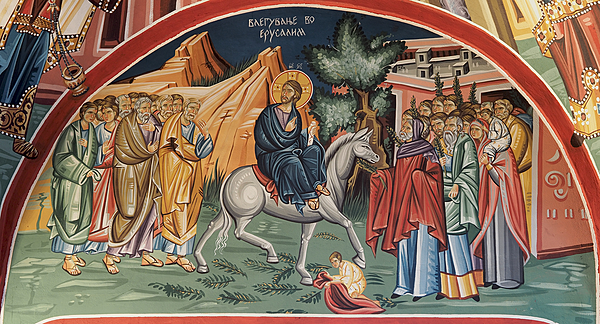
Today is Palm Sunday, when the promised Messiah son of Joseph was acclaimed by his people as he came to Zion, but subsequently, in fulfilment of Scripture, was slain in saving them, and was even rejected by the nation (though ascending to God), leading to a new exile for Israel until the coming of the Messiah son of David as a conquering king, inaugurating the eternal kingdom of God.
Such, at least, was one variation of the eschatological expectation of many Jews in second temple times. David C. Mitchell documents this in 428 pages in his classic 1997 book, The Message of the Psalter. Apparently whilst it was out of print, copies were on sale for $2999, but his reprint is very reasonably priced, and eye-opening.
Mitchell’s thesis, very persuasively stated, is that the final form of the Book of Psalms is by no means just “a temple hymn book.” Instead, it follows an eschatological prophetic programme most clearly laid out in Zechariah chs. 9-14, though it is consistent with many other passages in the prophetic writings. Mitchell cites extensively from second temple Jewish literature and rabbinic sources to demonstrate how well-accepted this general view of the future was, albeit it with a range of differences in interpretation of detail.
Messianic hope in Israel was more complex than we often suppose, as Mitchell shows both in this book, and in his later Jesus: the Incarnation of the Word. Jews were expecting, from their understanding of Scripture, the authoritative Prophet like Moses of Deuteronomy 18:18 (cf John 1:21), which Matthew’s gospel makes a major part of its treatment of Jesus, and they also looked for an eschatological high priest descended from Aaron (cf Zechariah 3:1-10; Jeremiah 33:19-22), which Luke reflects in the Levitical forebears of the Virgin Mary.
But as regards actual designated “Messiahs,” their reading of Scripture led them to expect both a suffering servant in the mould of Joseph, glorified after humiliation and rejection by his own people, and a triumphant king from the house of David who formed the bulk of messianic expectation. Mitchell points out how both of these (and not just the Davidic descendant of Judah) were traced back to the prophetic blessings of Jacob on his sons in Genesis 49 (vv.9-12 for Judah, and vv.22-26, of greater length, for Joseph). Interestingly, Mitchell points out how John’s gospel seems to present Jesus primarily in the manner of the son of Joseph, perhaps because as a Galilean from the territory of the northern kingdom, this was especially important to him. Contrast that with Luke, who says far more about Jesus as David’s descendant. Mark, in my view, emphasises particularly the revelation of Jesus’s divinity.
Much could be said about the distinctions in the role of these Messiahs from Ephraim and Judah, as Messianic hopes are presented in the prophets. But one interesting point is how the second temple literature often conflates the identities of these various figures.
So it is by no means absurd that Jesus might fulfil all these roles in one person. He could the New Moses by divine appointment. He could be the heir of David’s throne by natural descent, and the descendant of Joseph (through the Davidic line’s intermarriage with Ahab’s family). He could also be a descendant of Aaron through Mary’s priestly line (though as Hebrews implies, female descent would not qualify him as a Levitical priest, and his high-priesthood is altogether more supernatural, through the mysterious Melchizedek). Additionally, as Son of Man from Daniel, Jesus’s own self-description, he is both the perfect representative Israelite, and mysteriously divine.
Nevertheless, the roles of the OT Messiah figures remain distinct in Jesus’s ministry, though in Christian thought, Jesus fulfils them all. What I want to focus on here is the eschatological programme itself that Mitchell finds in the prophets (especially Zechariah), in the final shaping of the Book of Psalms after the Babylonian exile, and in second temple and rabbinic literature. in other words, it was a common, if not universal, outline of the future leading up to the time of Jesus. As Mitchell summarises it, the stages are:
- 1 The ingathering of post-exilic Israel under an eschatological king.
- 2 The gathering of hostile nations against Jerusalem.
- 3 The death of the king, and a new exile of Israel.
- 4 The regathering of Israel, and the divine rout of a consortium of hostile nations.
- 5 The nations ascend to worship at the Feat of Tabernacles in Jerusalem, in the new age.
Humanly speaking, this is an astonishing form for a national hope to take. Clearly, second temple Jews could point to the partial return from exile as an accomplished event. But the rest would be future, so why (apart from divine inspiration) would anyone look forward to their (Ephraimite) Messiah dying to bring salvation, leading to a further ignominious exile of indeterminate length, before a further invasion by the nations to be defeated by a Davidic Messiah, which is still in the future even in 2026?
What the Christian can say is that points 1b-3, somewhat condensed, were fulfilled in Jesus. Hailed on that Palm Sunday as Israel’s king, conquering sin and death on the cross, executed by a hostile nation and the corrupt shepherds of Israel, he had predicted the destruction of Jerusalem on the Olivet Discourse, which was fulfilled in 70AD and, more finally, at the defeat of the Bar Kochba rebellion in 135, when Jews were exiled from most of Judaea.
This last event led to a Jewish exile which lasted until 1947, with a return Jerusalem only in 1967. Without presuming to predict the future, the fulfilment of the Gog-Magog prophecies of Ezekiel has seldom looked more politically plausible than this year.
But my point is not so much the uncanny accuracy of this unfolding of history in line with a pattern found in the Old Testament, but that this outline was common currency in the time of Jesus. Mitchell’s survey of texts shows how the “eschatological exile” of Israel is linked to statements about the Gentiles coming to acknowledge Yahweh, and this would make sense if Jews were scattered across the world. The New Testament shows this in action (consider how Paul’s Gentile mission benefited from the Jewish diaspora), but also explains (Romans 11:25) God’s strategy in making the ingathering of the Gentiles dependent on Israel’s long exile.
Just as Jesus implicitly prophesied the scattering of the Jews in his Olivet discourse, he also predicted his return (in triumph, as the Davidic Messiah) consequent to the spread of the gospel to all nations. We have the Great Commission in Matthew, the preaching to all nations in Luke-Acts, and the “sheep not of this fold” in John. Even apart from the Zechariah eschatology, world evangelism would certainly be a long-term task. Linked to the prophecies of another exile, Jesus must have known that the end would not be soon.
Yet liberal theology (notably Albert Schweitzer, of course) has taken the Olivet discourse and texts like Matthew 26:64 as evidence that Jesus expected a rapid vindication from heaven, and the end of the age, but got it wrong. I think Mitchell’s work shows, indirectly, that that is a false view, for even many Jews had already, for centuries, seen Messianic salvation as a prolonged, two-stage process, even to the point of expecting two separate Messiahs, as rabbinic Jews still do.
Their confusion, perhaps, arises from seeing “the Son of Man coming on the clouds of heaven” as referring to Jesus’s return, whereas Daniel speaks of it as his coming to heaven and receiving power at God’s right hand. Perhaps Jesus was astute enough not to misread the prophet! But that’s a story for another day.
I’m not sure whether it’s more amazing that Jesus was able to speak correctly about the historical shape of the following two millennia, or that Zechariah and the Book of Psalms laid out the same story several centuries earlier. Either way, it’s pretty cool to see part of its unfolding in one’s own lifetime.