When I wrote The Generations of Heaven and Earth I was concerned with the setting of the biblical Adam and Eve in history, which overlapped with their role in the ancestry of the present human race. This involved discussion of possible geographical settings for Eden, and for the Table of Nations in Genesis 10. This in turn raised the question of possible sites for a regional flood involving Noah.
I explored how, although there are many problems (as with any possible geography of Genesis 2-11), a northern situation for both Eden and the flood has a lot going for it, albeit balanced by some strengths to a southern Mesopotamian alternative. In particular, one strong theme of Genesis 1-11 is that bad things and bad people tend to spread east from the point of origin, a directional theme reflected in questions of exile and redemption throughout the Hebrew Scriptures.
Of course, the “mythico-historic” genre of these chapters precludes either geographic or historical certainty. We may certainly speculate on connections with known historical events and reigns, but the history of the region is very complex and poorly known. That we have the cuneiform records we do possess, and can translate, from those distant times is pretty miraculous in itself.
Because of the scope of my book, then, I didn’t examine one contested question: the actual place of origin of Abraham, whose story in Genesis takes us into much more solid historical territory. Nowadays most of us have heard that Abram came from the southern Mesopotamian metropolis of Ur, and we are mostly unaware that this assertion dates only from the excavations of Leonard Woolley at Ur in the 1930s.
The attribution in itself raises problems, in that since the Bible refers to Ur-Kasdim, translated as “Ur of the Chaldees,” it is the basis for accusing Genesis of anachronism, as the Chaldeans only migrated to, and came to rule, Ur many centuries after Abraham’s likely life in the 19th-18th centuries BC.
That is scarcely a serious problem, in that updating place-names to make sense to later readers has always been common. Yet there are other candidates for Abram’s Ur, some of which had ancient traditions amongst Jews, Christians and Muslims long before Leonard Woolley made his connection on no strong evidence. The text itself is a clue, for to specify “Ur Kasdim” may well suggest a distinction from the more famous city. As one writer points out, unqualified “London” signifies England’s capital to the whole world, but if the writer means “London, Ontario,” then he makes sure to add the qualifier.
In fact the Western-Semitic speaking Chaldeans came from the west, and might well have been around to designate cities in Abraham’s, or at least Moses’, time. Furthermore the Genesis Table of Nations indicates no migration of Abraham’s line from Shem that would account for their arrival at the shore of the Persian Gulf from the general area of Urartu, where the ark came to rest. On the face of it, they stayed put whilst the Babel crowd moved east into confusion.
Interestingly the Christians native to upper Mesopotamia call themselves “Chaldeans.” Historically they occupied the city of Şanlıurfa, formerly called Edessa, and originally named “Urfa,” Şanlıurfa simply meaning “Urfa the Great.” There are strong traditions in that city that it is the birthplace of Abraham.
Such a setting would make much more sense of the biblical narrative, as following the death of his son Haran, Abram’s father Terah sets out for Canaan, but instead settles at Haran (still known as Harran today). This is on the obvious route they would have taken south, whereas Haran was well off the trade route they would have followed from Woolley’s Ur. Furthermore, another biblical text places Abraham’s birthplace as “north of the river (Euphrates),” which is true of Urfa, but not Ur, which was on its south bank.
Urfa appears to have developed into a city between 2500 and 2000BC. A little online searching shows a likely candidate for the original site at Kazane Hoyuk, a tell a few miles from modern Urfa.
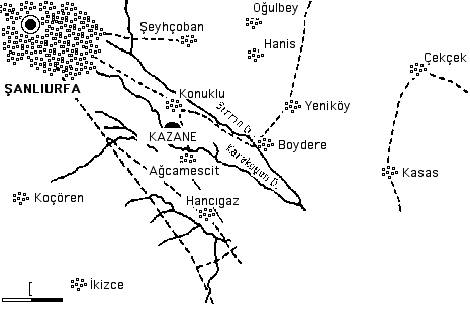
What is more, a few cuneiform tablets have been found there, at least one from the approximate period of Abraham. This demonstrates that it is by no means impossible that a literate Abraham could have carried the ancient proto-history of Genesis 2-11 with him on his travels on clay tablets, thus preserving for us a version of that history possibly closer to the events than those found further east by archaeologists.
One of these tablets suggests connections with a known king from that time, Shamshi-Adad I, who forged a large kingdom in northern Mesopotamia by conquest for just a single generation. This kingdom appears not to have included the Urfa city-state (as far as our scanty records show), though it evidently influenced it from the contents of the tablet discovered there. The kingdom did, however, include Haran. Although it would be foolish to invent motives for Terah’s movements, this does give us a flavour of politically unsettled times.
We can imagine Terah’s migration being to escape conflict (perhaps the cause of his son Haran’s death there?), or to benefit from commercial opportunities offered by Shamsi-Adad’s empire. Likewise, we can conjecture that Terah might have stayed on in Haran because the king’s death, and the collapse of his regime, made staying on more attractive – whereas Abraham was obedient to God’s call to abandon the pagan moon-worship for which Haran was famous.
We are vanishingly unlikely ever to find an archive in Kazane Hoyuk that includes Haran’s death certificate or a bill of sale for Terah’s house. But once again we find that the more we discover, the more plausible becomes this ancient text describing individuals and events nearly four thousand years ago. A people liberated from slavery might, perhaps, claim origins from a prince of the great Babylonian civilisation of Ur. But why would a nation claiming the territory of Canaan as their God-given possession, and whose culture derived from 400 years in Egypt, invent ancestors hailing from relatively insignificant cities far to the north? They remembered that “a wandering Aramean was my father” only because he was.
This means that further archaeology is only likely to increase our understanding of the sacred scrolls, and to justify our trust in them.
