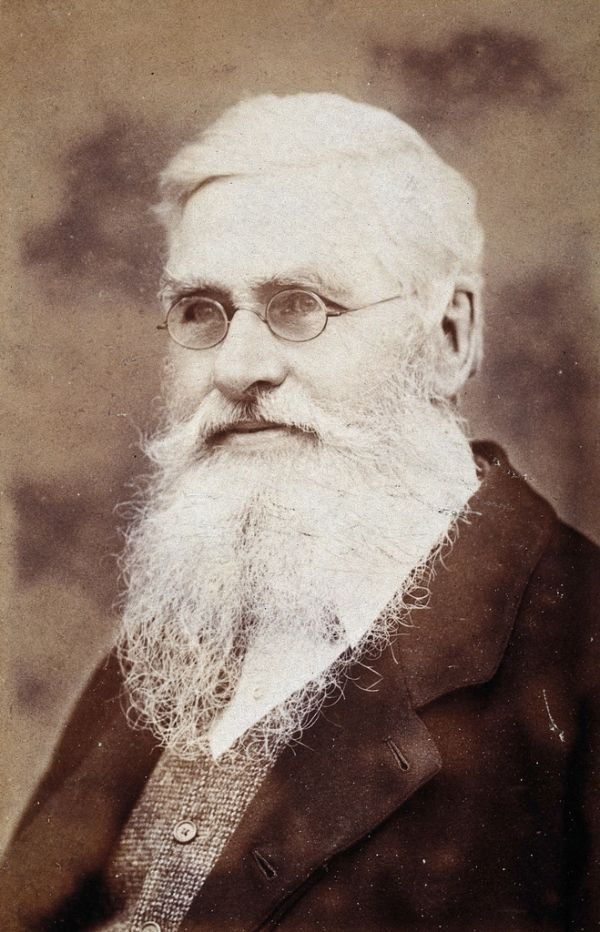
It was a writer on COVID, which one I’ve forgotten, who recently pointed us to this 1898 book by the great Alfred Russel Wallace (co-discoverer, with Charles Darwin, if you’ve forgotten, of the theory of evolution by natural selection, though he was far better than Darwin in realising its limitations). So I’m reinforcing that modern writer’s application to the present here, rather than discovering anything new myself.
Wallace wrote as a response to a Royal Commission into smallpox vaccination and the compulsory legislation surrounding it, and speaking as one of his century’s greatest scientists he did not hold back in condemning both the Inquiry and the whole practice of vaccination. He concludes:
The successive Vaccination Acts were passed by means of allegations which were wholly untrue and promises which have all been unfulfilled. They stand alone in modern legislation as a gross interference with personal liberty and the sanctity of the home; while as an attempt to cheat outraged nature and to avoid a zymotic disease without getting rid of the foul conditions that produce or propagate it, the practice of vaccination is utterly opposed to the whole teaching of sanitary science, and is one of those terrible blunders which, in their far-reaching evil consequences, are worse than the greatest of crimes.
That paragraph in itself could more or less be applied to the English COVID Inquiry, based on the critiques of UK policy, including mRNA “vaccinations,” made by many notable scientists, and even by my own unworthy self, since 2020.
In many ways Wallace’s twelve excellent charts alone reveal exactly the same issues with smallpox vaccination that books like Dissolving Illusions by Suzanne Humphries and Roman Bystrianyk have demonstrated in the present century, about vaccination generally. And I don’t recall that these authors even draw on Wallace’s work, though I may be mistaken there. The best statistics show that the incidence and mortality of smallpox began to drop rapidly towards the end of the eighteenth century, and that the introduction of vaccination around 1810 made very little difference to its decline. In fact, although the picture is clouded by the overcrowding and squalor in the big cities through industrialisation, before the mitigations of clean water and adequate sewers, some of his evidence demonstrates an exacerbation in smallpox in relation to vaccination, additional to the morbidity and mortality of the practice itself.
His best test-case of this is the city of Leicester, which after unusual zeal in vaccinating nearly all its population suffered one of the worst outbreaks of smallpox of the century, after which local policy was reversed and vaccination rapidly dropped almost to zero – as did further cases of the disease.
The great improvement in public health measures during the latter half of the century saw smallpox almost disappearing, despite reduced penalties and consequently lower vaccine uptake. The overall picture supports Wallace’s claim that it was better living conditions that saw the back of smallpox, as indeed is the case for every infectious disease examined in Dissolving Illusions and in Wallace’s book alike.
But what really is astonishing is just how closely the evidence Wallace gathers foreshadows the errors, vested interests, group-think and sheer intellectual incompetence that emerged in the 2020 phenomenon. It’s a really depressing reflection on human nature. I’ll mention just a few that come to mind, but recommend Wallace himself, whose book is a good read, for the full exposé.
The whole 2020 playbook is there. I’ve already mentioned the introduction of a strategy for a condition that (like COVID at the onset of lockdowns) was already declining. But within a couple of years of Jenner’s announcement, the entire medical profession seems to have agreed, without any good evidence, that vaccination was completely safe, and effective for life.
Consequently, doctors observing deaths they knew to be directly caused by vaccination knowingly substituted general causes such as “erysipelas” on the death certificate, deliberately “to avoid casting aspersion on vaccination.” Fast forward to the recent suppression of research on mRNA agent damage “to prevent vaccine hesitancy.”
In the same vein, statistics on vaccination status in cases of small pox were as skewed as the recent practice of discounting vaccine side effects in the first 14 or 28 days and classifying victims as “unvaccinated.” Victorian doctors sometimes ignored patient testimony of prior vaccination because there was no visible scar, despite well-documented evidence that scars disappeared in many vaccinated people. Scars invisible because covered in active smallpox vesicles were also treated as non-existent. In at least one case reported by Wallace, the presence of smallpox was taken as proof of non-vaccination, and entered into the official returns accordingly. Smallpox, like SARS-CoV2, became thereby an epidemic of the unvaccinated.
Wallace also points out that adverse effects of vaccination – in a good number of cases fatal – were hardly likely to be admitted by the very doctors who had vaccinated them (compulsorily) , or if not, wanted to maintain the profession’s reputation, or didn’t want to “cast aspersion” on the operation either through the quasi-religious “safe and effective” dogma, or because their colleagues were committed to vaccination and would ostracise them. It’s all so familiar from COVID, isn’t it?
A less direct reason for blind commitment to the virtues of vaccination, from both profession and government, was that almost immediately Jenner had been awarded £10,000 of taxpayers’ money for his discovery, followed by another £20,000 – adding up to around £3m or more in today’s money. Funding for vaccination programs was additional to this, and of course much of this went towards medical staffing. A lot of livelihoods, and even more reputations, depended on vaccination being “safe and effective.”
Another parallel to the COVID situation is the penalising of victims, by blaming the unvaccinated for catching smallpox or causing outbreaks, who in many cases had probably been vaccinated anyway, but were simply not believed. Then again we see the same kind of legal persecution, once vaccination was compulsory, that we saw during the collective madness of COVID policy:
And, as an instance of how the law is applied in the case of the poor, we have the story told by Mrs. Amelia Whiting (QQ. 21,434-21,464). To put it in brief, it amounts to this: — Mrs. Whiting lost a child, after terrible suffering, from inflammation supervening upon vaccination. The doctor’s bill for the illness was £1 12s. 6d.; and a woman who came in to help was paid 6s. After this first child’s death, proceedings were taken for the non-vaccination of another child; and though the case was explained in court, a fine of one shilling was inflicted. And through it all, the husband’s earnings as a labourer were 11s. a week.
That reminds me of cases like those known to be as risk of anaphylactic shock, or otherwise harmed by initial does of mRNA, being forced to be vaccinated nevertheless.
I could go on, but as I have said, you’ll do better to read Wallace’s account. But his most immediately relevant observation relates to his critique of the official National Inquiry which prompted his work. He observes that the only valid way to assess the effectiveness or otherwise of vaccination was through the rigorous analysis of the data by statisticians (think Prof. Norman Fenton, in our own time). But, he complains, there was not a single such person on the panel, and nor was statistical work reflected in the conclusions. His words on this could, I’m sure you’ll agree, be quoted verbatim as a complete response to the Hallett Inquiry:
A commission or committee of enquiry into this momentous question should have consisted wholly, or almost wholly, of statisticians, who would hear medical as well as official and independent evidence, would have all existing official statistics at their command, and would be able to tell us, with some show of authority, exactly what the figures proved, and what they only rendered probable on one side and on the other. But instead of such a body of experts, the Royal Commission, which for more than six years was occupied in hearing evidence and cross-examining witnesses, consisted wholly of medical men, lawyers, politicians, and country gentlemen, none of whom were trained statisticians, while the majority came to the enquiry more or less prejudiced in favour of vaccination. The report of such a body can have but little value, and I hope to satisfy my readers that it (the Majority Report) is not in accordance with the facts; that the reporters have lost themselves in the mazes of unimportant details; and that they have fallen into some of the pitfalls which encumber the path of those who, without adequate knowledge or training, attempt to deal with great masses of figures.
To quote an obscure children’s sci-fi writer (a prize for anyone who identifies him):
“A physician has a necessity for a statistician to enumerate his psychological and physiological meanderings.”
But when I shared some of this with an academic relative over Christmas, another family member (from the artistic professions) explained, “Jon’s an anti-vaxxer. I take my COVID and flu jabs every year, and I haven’t had COVID or flu.” Now that’s what I call evidence. Everything else is lies, damned lies, and statistics.