
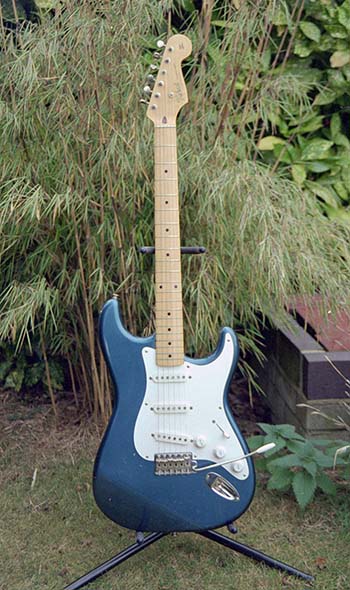
I’ve just given my Stratocaster guitar to my granddaughter, having decided I’m unlikely ever to join another rock band. And in any case, I still have a Telecaster. It’s not a Fender Stratocaster, you understand, but a Japanese Tokai, though when it was made, in 1984, their quality was arguably better than the the CBS Fenders of the time, and certainly superior to Fender’s Japanese Squiers, one of which I bought in 1983, but was never entirely happy with.
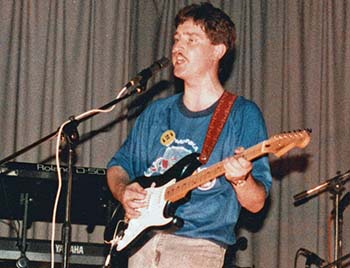
Granddaughter is ten, going on eleven, and has been learning guitar for a couple of years and making great progress. That is the age at which I first wanted a Strat, to be like Hank Marvin, though I had to wait another twenty-three years to afford mine. This one, in tasteful metallic blue, I swapped for a Roland guitar synthesizer in 1986. So it’s been my mainstay electric for forty years in several bands, in many church services, and in a lot of home recording. Apart from a bit of fret wear, and minor modifications like rewiring the tone controls and fitting a new nut, it’s pretty much original.
Not only does it sound great, but I like to think that somehow all the music it’s played is still somehow ingrained in it, and if only through mental association that this will enhance granddaughter’s playing for many years to come.
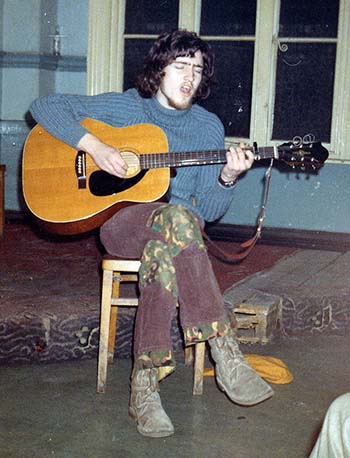
That certainly is the case for me with my original Ariana acoustic guitar, bought used for 15 quid in 1970, and after a recent re-fret now as comfortable to play as an old pair of slippers. The companion of literally hundreds of performances, if I chance to play something from those early days, I find myself saying, “Remember this one, old girl?”
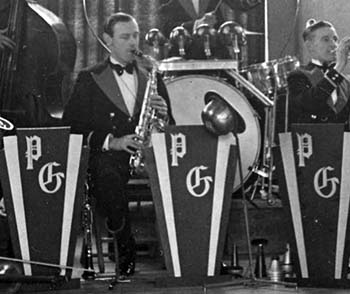
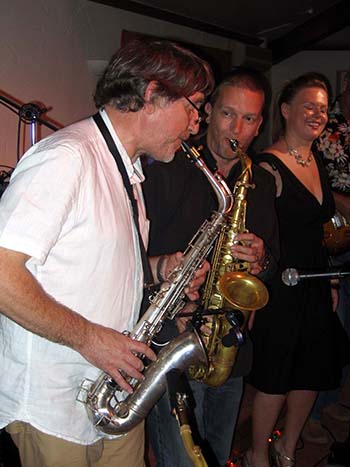
That weight of association is even stronger in instruments I’ve inherited across generations. My 1930 Selmer alto sax, bought by my Dad in 1936, and familiar my whole life, still seems to retain the echoes of swing-era dance music, though with a Morgan Excalibur mouthpiece it is able to scream out the solo from Supertramp’s Logical Song. Close on a century of tunes, mostly family tunes, seems to reside in the brass and silver.
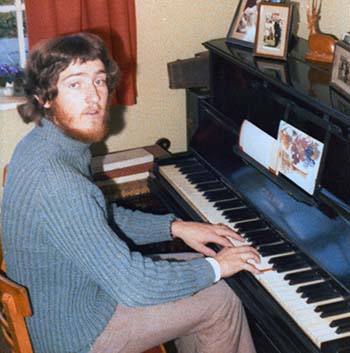
Our old piano at home came from an even earlier generation, being the gift of my maternal grandmother, and retaining in its timbers her lifetime of accompanying herself singing Methodist hymns in front rooms from Faversham to Exeter. I bashed out my childish compositions on it, and my kids identified my mother as “Granny with the piano,” as opposed to “Granny with the fish pond.” Our instruments overlap five generations.
To me, musical heirlooms are therefore far more consequential than other inheritances: a painting or a jewel may have been seen by many generations, but an instrument has channelled their deepest creative energies.
The sense of these instruments passing the ghosts of music past down the years, and down the generations, may of course be entirely fanciful. But for the non-musicians among you, it’s rather like that feeling you get visiting an ancient cathedral or parish church. There the sense of awe is not so much because these are “holy places” (for in the gospel age the shekinah glory dwells in Christ and his Spirit-endowed disciples, not in sacred places). Rather, it arises from the fact that worshippers have gathered here for so many centuries, and left some special mark upon the place.
There is a practical value to this sense of holy continuity, whether it is mystically real, or a reminder that past generations of saints are still a “cloud of witnesses” as in Hebrews 11, or whether it’s purely an intellectual and emotional reminder that our generation does not stand alone, but as part of a bigger story.
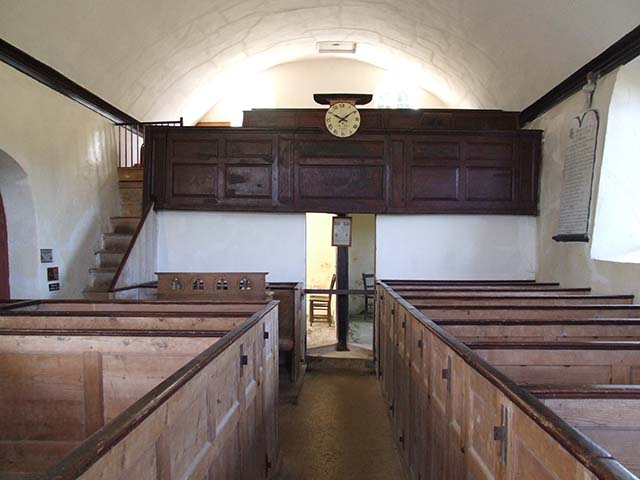
From my garden I can see in the distance the chapel built by my Baptist church in 1653, and to visit it is to feel that sense that the walls somehow retain 373 years of faithful discipleship. And that reminds many of our present members, usually meeting in a nice modern building, that we are only custodians of our forebears’ work, with a responsibility not to fritter our inheritance away.
Sad to say, the sense of cultural continuity is being deliberately eroded in every area now. It’s depressing to hear my own children dismiss this by saying, “Change just happens,” even when son-in-law’s ancient cathedral school has had to close after eight centuries, because of the government’s vindictive tax raid. I question whether, when air-travel is banned or Sharia law imposed, they will wish they’d been a little more active in fighting to preserve what their ancestors won for them.
As has been often said, the present owes a debt to the past. Maybe that’s true for inherited Tokai Stratocasters or Selmer saxophones. It’s definitely true for national cultures and identities. And it is of vital importance in religion, in which eternal salvation and eternal damnation are dependant, contra the progressive denominational leaders or kings leaning towards Islam, on the testimony of the eternal Son of God. As Jude wrote:
I felt compelled to write and urge you to contend for the faith that was once for all entrusted to God’s holy people.
Think of the rock from which you were hewn when you play that axe, Granddaughter!

Takes me back to a very long time ago when an elder was explaining Communion to us, and I asked “So symbolism is important to God, then?” and his answer was: “No, it’s important for us”.
If we think of “information” in the sense of “meaning,” then pretty well everything that matters is symbolism!