
When I was writing The Generations of Heaven and Earth I made extensive use of John H. Sailhamer’s The Meaning of the Pentateuch. It was somewhere in that large tome, if memory serves, that he wrote something to the effect that theology should not be concerned with historical events, as such, but with the Bible’s record of historical events.
I found that shocking, until I came to understand it better. Was he really saying that the study of archaeology to corroborate the Bible is useless? Or that studying the natural sciences should be spurned in favour of contemplating Genesis 1 alone? Or that artistic representations, such as Passion Plays or paintings of biblical events, should be avoided?
Worse still, should we interpret him to mean that what biblical authors wrote about an event matters more than the event itself? That the Passion, or the Passover, only matter because they are written down in Scripture? That sounds dangerously close to saying, like the Victorian liberals, that history doesn’t matter to salvation, but only faith: if Jesus never actually existed, it wouldn’t matter because it’s the thought that counts. Surely historical faith is grounded on facts like the actual deliverance of a nation from Egypt, and supremely from the death and resurrection of the incarnate Son of God in history?
Sailhamer was not, of course, implying any of that. I was put in mind of it by a conversation with a sister recently, who waxed enthusiastic about the film series The Chosen. She said how brilliantly it brings to life the gospel accounts. But in contrast, this week, a member of my Bible Study group independently mentioned The Chosen, saying that she’d investigated it and found some dubious links to the Church of Latter Day Saints, with consequently dodgy on-screen dialogue. That led to a fruitful discussion on the benefits and dangers of exposure to arts with potentially deceptive ideologies, but that’s another story.
I believe The Chosen is on Dizley Channel, or Flick-knife, or another of those networks I can’t access, and so I can’t comment on its credentials. But the episode does demonstrate that we can only “bring history alive” through the endeavours of humans who have their own agendas. And even were we to have been present at major biblical events, our own human agendas would in all probability have masked their spiritual significance.
A case in point is Mark’s Passion account, which was the theme of my last post. To the disciples-on-the-ground the events of Jesus’s arrest, mock-trial and crucifixion signified the end of their supposed Messiah, and likely death for themselves. That was compounded by the fact that no one disciple witnessed every stage of the catastrophe. How much more would the Jerusalem crowds have perceived only the come-uppance of a false prophet, whether deserved or not? But the Holy Spirit, inspiring Mark to write his gospel (whatever mental journey that actually involved), revealed that the apparent defeat was actually nothing less than an Imperial cosmic Triumph.
To return to Sailhamer’s territory of the Pentateuch, those of us old enough to have seen Charlton Heston in The Ten Commandments in our childhood may, like me, remember the Passover only by the memorably spooky depiction of the Angel of Death passing over the land as a green claw.
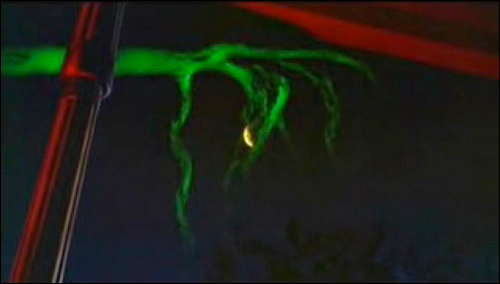
It is very scary (when you’re six), and very cinematographic – but it is not what Yehovah tells Israel, in their torah, to recall every year when they commemorate the Passover in their families. The judgement on the firstborn is briefly described, and the angel mentioned (but not a skeletal green claw), but the focus of the ongoing remembrance is on driving home to Israel that their fathers’ deliverance is their own deliverance. History is brought to life annually as spiritual meaning through the biblically prescribed form of remembrance.
Sailhamer’s overall thesis is that the meaning of the torah is to be understood from the way the books, as they have been transmitted to us in their canonical form, present the events God brought about. In particular, he draws attention to the role of poetic passages placed at what he calls the “compositional seams” of the work. That leads us to read behind the superficial history of how Moses led Israel into Canaan to a deeper theme of the inevitable failure of the Mosaic covenant and the prophetic hope of the Messiah.
A similar point could be made about what we call “the historical books” of the Old Testament. Archaeology has been remarkable in corroborating, and even clarifying, the history of Israel during the time of the judges, then the kings, during the Exile, and after the return under Zerubbabel and Joshua the priest. To see the seal impressions of biblical figures from the City of David, or the excavated remains of Shiloh, is both revealing to the mind and encouraging to faith.
But it is significant that the Jews did not classify the biblical accounts of these things as “history”, but as “the former prophets.” We know the name of some of them – Samuel the seer, Nathan the prophet and Gad the seer (1 Chronicles 29:29), and other notable prophets like Elijah and Elisha, and Isaiah almost certainly were involved in compiling the later stages. They in turn sometimes refer us to sources like the royal chronicles for “the facts,” whereas their interest is the meaning. This especially concerns the progressive failure of Israel’s kings to be the fulfilment of the Messianic Covenant made with King David, and hence the need to live in hope for Messiah’s future coming.
The problem with historical biblical reconstructions, whether academic or popular, is that they can teach us to focus on vicariously experiencing the facts, whilst they may fail to highlight, or worse still actively distort, the meaning that God teaches us through his written word. That would be an especially grave danger to the spiritually immature if the purveyors of that history were false teachers.
And so when, a couple of years ago, I saw a cartoon version of the Lord’s ascension intended for children, for all the presumably good intentions, I saw nothing of the event’s spiritual significance, translated into a form children might understand. Instead the figures were comical rather than significant (imagine Hamlet or Macbeth done by South Park, but wearing tea-towels). Worst was the depiction of Jesus, who was shown with large, unexplained, holes in his hands and feet (through which the background could bizarrely be seen), and who finally disappeared into thin air as if by magic, rather than ascending to the holy realm of the Creator. How could that ever move a child towards true repentance and faith?
The key, I think, is to escape from the Liberal (and Progressive Evangelical) lie that the Bible was written by fallible men struggling to make sense of the acts of God in the world. Rather, Genesis and John’s gospel teach us that the Father who created the universe by speaking his Word by his breath, the Holy Spirit, created Scripture in the same way. Because Scripture is God-breathed (2 Timothy 3:16), it conveys the eternal thought of the Father because what God, in the Person of his Spirit (Hebrew ruach) breathes out is his Word (Hebrew dabar, Greek λογος), also a Person, who was with God “in the beginning” (John 1:2). How else could the word of God be “living and active” (Hebrews 4:12)?
There is the small matter that a mind indwelt by the Spirit is necessary to appreciate the meaning the natural man cannot see in Scripture (1 Corinthians 2:14). But I hope you can see that, however good The Chosen is, or the scientific findings of a Kenneth Kitchen or a Turin Shroud investigation team, they were not breathed out by God’s own Spirit or embodying his living Word, Jesus. That is what makes the Bible more than just a sacred text.
Postscript: Although I’ve not yet read it (owing to the price!), Steven M. Bryan’s The Visible Word of the Unseen God: Reading John Among Rivals Old and New appears to present some similar ideas, based on a reading of John’s gospel that sees it mainly as an apologetic to sceptical Jewish readers about the possibility of divine incarnation. John, he says, argues that God’s Word became visibly present at Mount Sinai in the torah, so that there is nothing inherently strange, to Jewish beliefs, in the Word later becoming incarnate in human flesh (and there is a solid reason for forbidding “graven images”). As in my post, only in greater theological depth, the book’s Amazon blurb argues: “As John renders the world, God is not absent from his creation but neither is his presence diffuse within it. Rather, the Creator is and always has been present in his Word. Through the incarnation, crucifixion, and resurrection, the Word has become the sanctuary that human beings co-inhabit with God and share in the life he lives and speaks.”

I have enjoyed the seasons of Chosen I have seen so far, though I remember one episode had my eyebrows raised (don’t recall why now, but that’s me discarding the cruft).
I know some people have felt it is too “iconoclastic”, I think in presenting Jesus as insufficiently aloof. And there are definitely liberties taken with the “filling” between the gospel stories, but generally I haven’t found them implausible, nor obviously counter-scriptiral.
But I think it has merit in presenting Jesus as a real person “like us, and yet…”. The aim, according to the director, was to “bring Jesus down from the stained glass windows”.
Obviously that is not an undertaking which is devoid of risk, but I think (so far) they’ve had a good shake at it, and for me as a Christian it has mostly provoked thought about my own ideas – because we also unconsciously bring our own “filling” to the story.
And I think that for a non-Christian it could awaken, or at least make understandable, the beauty and attraction of the person of Christ, in his humanity and divinity, in his wisdom and compassion, in his tenderness and authority.
Indeed – the mediaeval Passion Plays had the same aim. As did the stained-glass windows, teaching that divine light shone through Jesus’s humanity. That last is quite difficult to achieve in an acted drama.
I heard recently that in the Passion Plays, the forgiveness of every sin was proclaimed… apart from the sin of brewing bad ale. Which, I suppose, shows that our recreations of Jesus will always, to a degree, cast him in our own image.
The thinking person will, like you, “spit out the bones” either against the touchstone of the gospels, or by understanding the biases of the artist. Satan is more interested in getting the poison pill through the lips of the immature. Which is not a direct comment on The Chosen because I’ve never seen it.
Your initial understanding of Sailhammer reminds me of John Walton’s philosophy, where he said in one of his books that the “event” is not inspired, but the “interpretation” is what is inspired. I still don’t understand how to digest that. If the theology is being derived from an interoperation of an event in the Bible but not the actual event, then how can it be trusted. Tangentially, if the progressive Christians claim it was written by fallible men, what is the traditional view, at least when it comes to the OT? I have asked Christian scholars how do they trust the OT and claim it was done under some concept called “inspiration” if the writers, editors and canonizers are for the most part all anonymous scribes. I don’t remember getting a good answer.
Hi Hanan – also welcome back.
I’m assuming that Walton (maybe I was misremembering him rather than Sailhamer) distinguishes “inspired” from “divine” or “supernatural.”
Take the Exodus event (in its entirety). Walton would, as a believer, take it as a series of Acts of God. But any phenomenon is open to a range of interpretations, witness the nineteenth-century liberals who accepted the parting of the Red Sea but bent over backwards to say that it was just a fluky wind with coincidental timing. The torah teaches differently, with an understanding given by the divine author of the significance of the events (inspiration), with the aim of maintaining the remembrance of the foundation acts of God in Israel.
Israel always had torah thereafter – but they had no direct access to the events. The OT prophets, in turn, had recourse to torah as the word (dabar) of God himself, as the profound intertextuality of the entire tanach demonstrates. I heard an estimate yesterday that the direct verbal cross-links across the Bible (including the NT in this case) number over 60,000. There are many more indirect links and allusions showing how the Bible writers themselves revere the writings, not just the historical events.
Now, of course, any archaeological corroboration of the Exodus informs us helpfully about the factual truth, or otherwise, of the Bible. But if we accept Scripture’s testimony that the surrounding nations heard what had happened and trembled, then the facts were not then in doubt, and it was the attribution to Yahweh, and what that implied for people, rather than to Ra’s displeasure with Egypt, that inspiration ensured.
I don’t see a distinction between a Christian view of OT inspiration and a traditional Jewish one. Christians, after all, adopted the Jewish canon which seems to have been settled during the second temple period, and that excluded for example Maccabees, despite its apparent accuracy and its religious nationalism, and Enoch, despite its strong influence on second temple Judaism. (There is no evidence that the inclusion of apocryphal books in Septuagint manuscripts indicated their canonicity).
There seem two questions in your question. The first is the nature of inspiration itself. The prophets had a high concept of “the dabar of the Lord,” which they saw not as predicting the future, but as determining it (just as God’s Word in Genesis 1 determined creation). The two objective canonical tests of a true prophet were (a) that his/her predictions never failed and (b) that he/she spoke according to the torah.
Peter (a second temple Jew writing NT Scripture) described inspiration in two places:
“Above all, you must understand that no prophecy of Scripture came about by the prophet’s own interpretation. For prophecy never had its origin in the will of man, but men spoke from God as they were borne along by the Holy Spirit” (2 Peter 2:20-21).
“Concerning this salvation, the prophets, who spoke of the grace that was to come to you, searched intently and with the greatest care, trying to find out the time and circumstances to which the Spirit of Christ in them was pointing when he predicted the sufferings of Christ and the glories that would follow. It was revealed to them that they were not serving themselves but you, when they spoke of the things that have no been told you by those who have preached the gospel to you by the Holy Spirit sent from heaven. Even angels long to look into these things” (1 Peter 1:10-12).
And Paul – also a second temple Jew prophetically authoring NT scripture, but in this case trained by the sage Gamaliel II – wrote, “All (OT) Scripture is God-breathed [cf Genesis 1] and is useful for teaching, rebuking, correcting and training in righteousness, so that the man of God may be thoroughly equipped for every good work” (2 Timothy 3:16-17). I think any greater insight would require that one was a prophet oneself.
I doubt any religious Jew would disagree with Paul on that (though it seems under Rabbinic Judaism the sages have, like the Roman Catholic hierarchy, delegated to themselves the sole right of interpretation).
However, that speaks to the second point in your question: why non-prophets trust the OT as inspired, despite its unclear history of authorship and redaction (transmission is rather more clear). In this question, we have to accept that there is a concept of Scripture as self-validating. But this is only comprehensible under the understanding that, as both Jews and Christians believe, God himself is in some sense powerfully present in the words (see Postscript above).
To Christians, it is the presence of the Holy Spirit in the believer, or convicting the unbeliever, that underpins that validation: God validates his own Word. I knew a man who came to faith in solitary confinement whilst serving a prison sentence, when he tore a page out of a Gideon’s Bible to roll a cigarette, and made the mistake of reading it. And my own Pastor, only yesterday, recounted how he was cajoled into going to church by his wife, thought the atmosphere and music were tolerable, but when the Bible was read and preached, his whole life was suddenly turned around that morning. My own experience is less dramatic, but equivalent.
History obscures how, and by whom, the tanach came to be treated as divinely, as well as humanly, authored, in second temple times, or before (for Jeremiah even quotes Isaiah as God’s word). But there is something unique about a book that has maintained the spiritual and national hopes of an entire people group through two exiles, the second lasting almost 2,000 years. Theologically, God’s Spirit was present amid his people’s leaders, if not promised to all until Joel’s prophecy should be fulfilled (see Acts 2), and perhaps that is all we can know about the original recognition of the OT.
So, despite the difficulties, reliable inspiration of the same text was claimed by Pharisees, Sadducees, Essenes and Samaritans (though by the last only of the torah); by Rabbinic and Karaite Jews now; by Christians Catholic, Orthodox and Protestant down the ages; by the Quran when not contradicted by the hadith, and at least potentially by those inquisitive souls who have been boosting Bible sales by 134% since 2019 even in cynical Britain.
Further – an interview here with Seth Postell deals with this subject of inspiration, with quotes from Sailhamer and a clip of John Walton. I’m pleased to say it doesn’t seem to contradict what I wrote above!