A nice academic-sounding title for a blog inspired by my post-Christmas reading, by dint of an inspired present from my wife’s academic cousin. It is Planet Narnia, by Michael Ward. Ward’s 2008 book proposes that C. S. Lewis built his seven Narnia stories around a secret scheme that based both their distinctive “atmospheres,” and the varying aspects of the Christ-figure, Aslan the lion, on the astrological features of the seven Ptolemaic planets.
The book was an immediate hit with me, referencing many of the thinkers who shaped my ideas in my “BioLogos period” in the 2010s, such as Owen Barfield, Michael Polanyi, Arthur Eddington, George Berkeley and Lewis himself.
As it happens, I’m entirely convinced by the thesis, knowing what a mediaevalist Lewis was and how he wove classical cosmology into his Ransom “space” trilogy, which I know a lot better than the Narniad. I won’t go into a detailed reflection here, reserving that for my wife’s academic cousin, but will just pick on one obvious motivation for Lewis’s employing the scheme. This was his conviction that the post-Copernican materialist view of the world, by disenchanting it, had impoverished human life.
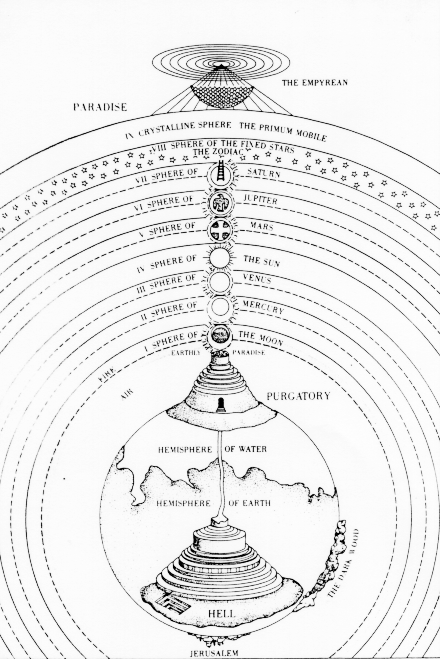
Mediaeval writers consciously requisitioned the Greek deities as imaginative proxies for the Christian God in their work, as is obvious from reading Chaucer, Dante or any classical poet. And they particularly focused on mediaeval cosmology, with the seven Ptolemaic planetary spheres both influencing everything in this world, and forming a hierarchical ladder to God in his highest heaven. As Lewis wrote:
They wrote it, they sang it, painted it and carved it. Sometimes a whole poem or a whole building seems almost nothing but verbalized or petrified cosmology.
To the mediaevals, of course, although they were fully aware that the pagan gods were fictional, there was a close correspondence with their Catholic worldview, which was theologically hierarchical, and they embraced astrology and the theory of humours in their understanding of the “sympathy” between the heavens and the earth, conceived more personally than mechanically. Psychologically, perhaps personified planets compensated for the remoteness of God in both their Catholic religion and their Ptolemaic cosmology.
The post-Newtonian Lewis, of course, was even more aware of the fiction, but conceived of truth and beauty as being separable. In any case, he felt that the beautiful old cosmology told truths that were almost lost:
There has been no delight (of that sort) in “nature” since the old cosmology was rejected. No one can respond in just that way to the Einsteinian, or even the Newtonian, universe.
In other words, modern children (and adults, for Narnia was always intended for them too) had no language by which to express, or even conceive, the vibrant immanence of God in his world – an immanence that Lewis felt keenly following his conversion. By using the old cosmology, hidden within the stories, in a new way, Lewis sought to excite the reader’s imagination to the reality of Christ in his world, modern reason having been blinded by philosophical naturalism.
Imagination is indeed an indispensable faculty in approaching an understanding of God (what Lewis referred to as “connaître” contrasted with reason’s equally important “savoir”). As an aside, imagination is as poor a tool as reason for communing with God – this is the delusion of mysticisms whether Charismatic or otherwise, which fool us into hearing or seeing God in our own thoughts. Scripture tells us that communion with God must be by the Holy Spirit, through the Word of the gospel and the sacraments.
However, the problem of channelling the imagination through mediaeval cosmology has become more acute since Lewis’s day. Even in my childhood, two decades after the Narniad, it was still plausible to write Science Fiction in which Mars was cold and its air thin, but breathable, Venus under its clouds was a verdant paradise (if you kept clear of the Mekon), and even Jupiter might be habitable. Interplanetary missions have, of course, permanently destroyed such illusions.
Meanwhile traditional remnants of astrology’s with astronomy have faded further. As one example, look at any record sleeve or YouTube thumbnail for Holst’s Planets, and you’re likely to see a photograph from the Hubble telescope, the fact that Holst’s music represented astrological influences having been all but forgotten.
Is there, then, any alternative way of firing our imaginations, and even our reason, with the presence of God in his world? The whole society has outgrown Deism (which ultimately depended on memories of the Ptolemaic Caelum Imperium with God as its Prime Mover, I suspect). Yet Evangelical theology remains largely materialistic in its understanding of God. Yes, the Holy Spirit from heaven indwells believers (perhaps like a suited astronaut holding out on a moon-base), but any other immanent act of God is seen as “supernatural,” either to be lauded as evidence of his existence or of the “anointing” of the person invoking it, or else rejected as anti-scientific. Over at BioLogos, divine action in the world was even seen as anti-Christian interference in the “autonomy of nature.”
I have no successor to Lewis’s vivid Narnian or Space trilogy imagery. But we might, perhaps, make a start by revisiting the biblical view of our God, and stepping back from current science to see just how re-enchanted nature is becoming in our day.
Take, for example, Richard Sternberg’s recent suggestion that the amount of information required for the cell-differentiation of any multi-cellular organism is orders of magnitude greater than the cell, let alone its genome, can possibly contain. The information, he says, must come from an external, immaterial, source. I’m reminded how Dr Arthur Jones told me, thirty years ago, that conventional biology has no theory of development, and he was dead right.
Sternberg is a platonist, so I believe conceives of a world of immaterial, though “natural” forms (C. S. Lewis had much to question in that word “natural”!). Yet we do not need a Platonic pagan fiction when Psalm 104:29-30 says:
When you hide your face,
[the creatures] are terrified;
when you take away their breath,
they die and return to the dust.
When you send your Spirit,
they are created,
and you renew the face of the earth.
Why is God’s Spirit, informed by Christ the Logos who sustains all things in being, not a credible source of immaterial, life-engendering, information?
We are also at liberty, surely, to take seriously the still intractable problems of the origin of life and the origin of the species, and to look back to Genesis 1 (embracing temple imagery) or to The Magician’s Nephew (engaging the Elysian imagination) for a more theistically plausible account than the remnants of Darwinism offer.
Likewise I think the state of science is now such that Genesis 2:7 can be held to represent a near-literal view of our own humanity’s origins, whilst Sternberg’s work brings the individual creation of each human soul quite close to the mathematical calculations of the laboratory.
If indeed God’s Spirit takes personal charge of individual creatures (“You knit me together in my mother’s womb” (Psalm 139: 13); “Not one sparrow will fall to the ground apart from the will of your Father” Matthew 10:29), then God’s providence over each and every event is entirely credible, and our world is an enchanted place indeed!
We will need to account for adversity and tragedy in such a world (which naturalism doesn’t even attempt), but that, after all, is what the mediaevals did in their use of the planetary gods. As Michael Ward points out, Lewis’s representation of Aslan in seven planetary guises, some benign, some terrible, actually describes the unfathomable Christ as King, Military Commander, Light, Son, Word, Life, and Mystery. The Bible itself has comparable images.
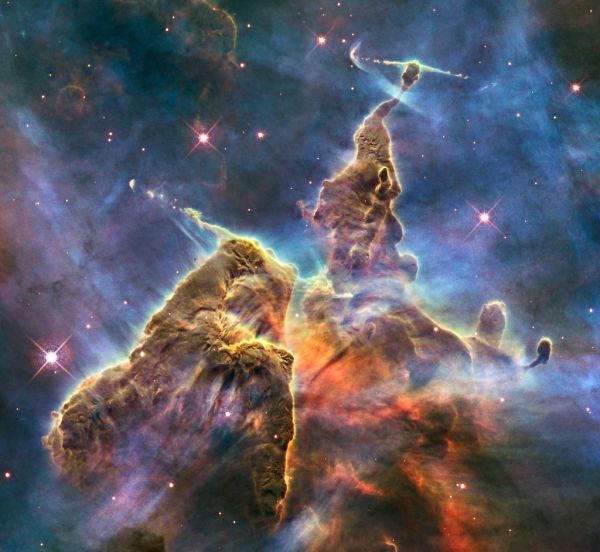
Even above the “sublunary” sphere (woops – Ptolemy strikes again!) the bleak view of “empty space” we grew up with has been steadily replaced by not only a staggering number of the “island universes” that were only discovered in Lewis’s adulthood, but a richly populated universe of diverse phenomena, many invisibly linking the worlds by fields or radiation. Our metals, it appears, were given to us from the explosion of other stars, our climate is affected by cosmic rays, and the whole cosmos is fine-tuned for human life. It may be true that most of that vast universe is uninhabitable to us (which makes our world as privileged as the Bible teaches, but then even the Ptolemaic cosmos was suited to angels, not men.
A God so intimately concerned with our world, and with everything in it, is the biblical God – and indeed the theistic God as opposed to a deistic clockmaker. Scientists will object (and I experienced it for a decade at BioLogos) that this is a God of the Gaps and a science-stopper. In fact, it just means that we have to reckon with the inscrutabilty of our Creator and Sustainer’s personal choices, as we do with the inscrutable choices of every human being who ever influences a scientific enquiry.
If indeed biological development information comes from an immaterial source, whether the world of forms or the intellect of the Spirit, it might be a little difficult to investigate it by physical methods. Or there might be some investigable cause and effect involved. But if not, that’s the way God’s world is, and what are you going to do about it?
One answer would be to glorify God and thank him for this plain demonstration of his power and divine nature (Romans 1:20-21). Another might be to excite children’s imaginations with the wonder of it in another series of stories.

I probably should also have mentioned the actual astrological resonances in the New Testament, which I wrote about here.
Having spent time recently with various persons afflicted with (what seem to me to be at least partly era-induced) mental health problems, I am struck by how much of our (human) world is on the inside. Someone who is otherwise in perfect health can be incapacitated by ideas. This seems to drive a cart and horses through the materialistic worldview we have grown up with (and which may be part of their cause). If in our experience of ourselves we are more being than matter, how does that relate to a universe which is only (allegedly) material?
That book looks very tempting.
You speak sooth – from the question of the elusiveness of material reality, to the excessive treatment of destructive ideas with drugs, as if thoughts were material objects.
If you really want to expand your mind on these questions (plenty of room, if it’s immaterial!), the go-to is George Berkeley (Philosophical Works, Cambridge U.P.), much derided but actually very helpful. Apparently Lewis thought his approach was irrefutable.