
One of the most useful learning experiences for any Christian is to gain an overview of the Bible, showing its different kinds of literature and how to read them, the background history, the reasons the books are in the order that are (in the Hebrew or English versions, or both), and most importantly, the overarching themes that make the 66 books one plan of salvation.
In my Generations of Heaven and Earth I suggest an absurdly simple scheme as an introduction to such a global understanding. I show how God’s overall salvation plan, which is the subject matter of the disparate books of the Bible, fits neatly into a common pattern seen in the world’s folk-literature. Since I’ve fished it out to teach some of our young people, I thought I’d share it with you here.
Folk tales and the “Rule of Three.”
God’s salvation plan is actually structured like a myriad of folk-tales from around the world, which follow a “Literary Rule of Three.” It is thereby obviously well suited to the human heart that so often represents narratives in that way! Understanding this helps you interpret almost any part of the Bible properly. The typical story pattern is:
- Someone in a happy setting makes a plan.
- But the plan is stymied by a malicious villain.
- So the first attempt at the plan fails, and the second also.
- But the third time a hero appears, who undoes the evil, destroys the villain, and fulfils the original plan. And they all live happily ever after.
Examples: Three Little Pigs, Three Billy-goats Gruff, The Good Samaritan.
To take the Three Little Pigs, an old father pig living in a forest (his back-story is irrelevant) sends his three sons out to make their way in the world. The first, being idle, builds his house of straw, but a villain appears in the form of the big bad wolf, who easily blows it down and (in the original) eats the wolf, though in the Disney version the piggie flees to the house of his brother. The latter is not quite so lazy, and has built his house of sticks, but the wolf makes short work of this second house (and, optionally, the second pig). The third pig, being wise, has built from bricks, and the wolf can’t blow the house down. In fact, by trying to enter by the chimney he ends up in a caldron of boiling water and is cooked and eaten by the surviving pigs. The third, hero, pig has therefore saved the situation (in th eDisney version!), destroyed the enemy, and enabled the father’s original plan to be fulfilled.
The Bible Setting (Genesis 1)
The Genesis creation is not outdated science or myth, but our world, God’s good, yet perishable, creation, only viewed as a holy tabernacle/temple separating God in heaven from mankind on earth, with the sky in between as a sacred meeting place (hence holy mountains as places where people meet God in the Bible: Sinai, Zion, the Mount of Transfiguration etc).
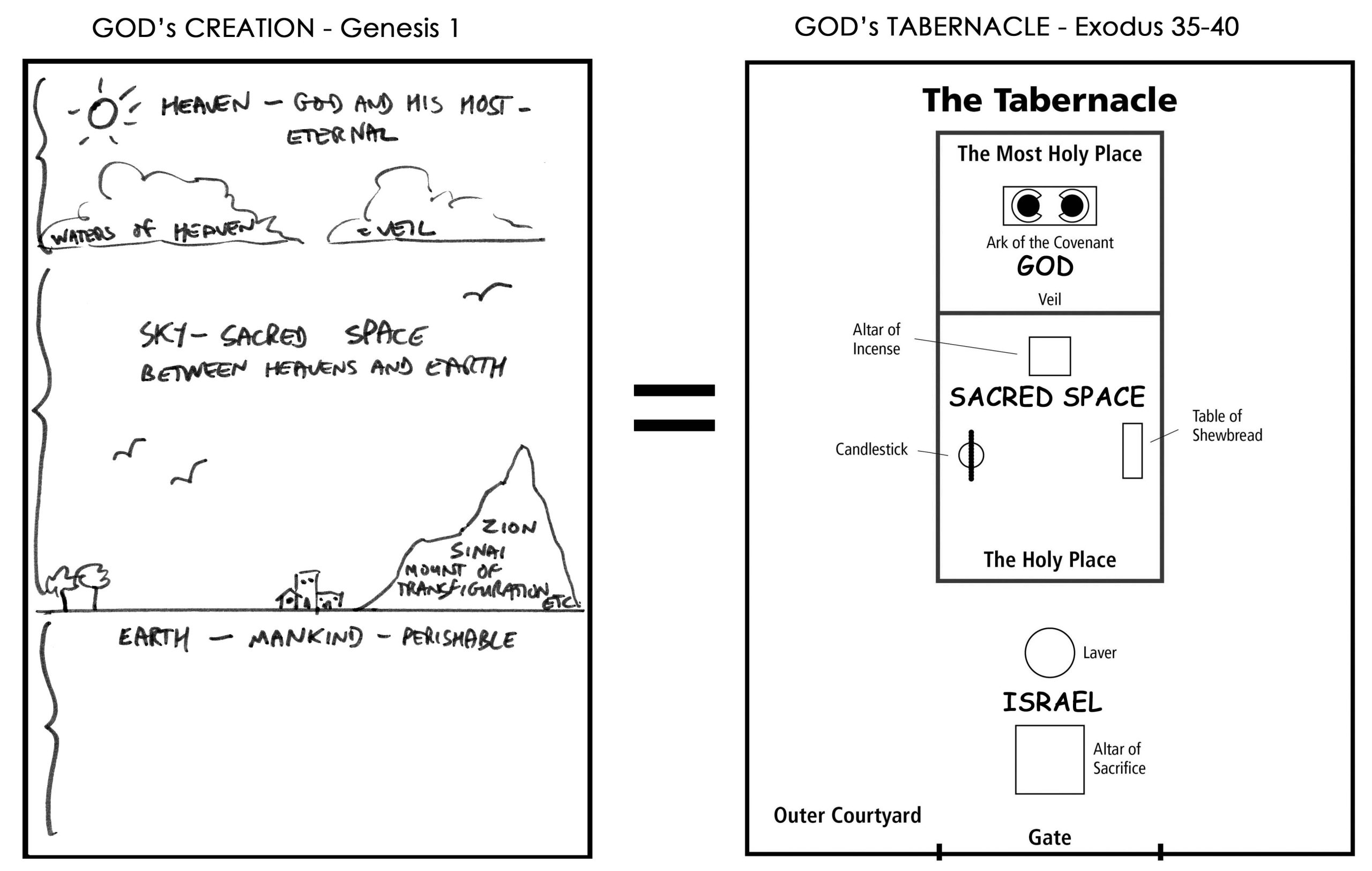
Episode 1 (Genesis 2-11)
God is the “man with the plan.” His grand scheme is to bring heaven and earth together into one realm, filled with his glory. He will do this by teaching mankind, made in his “image and likeness,” but perishable like the earth, his own wisdom and righteousness, and giving them eternal life and a share in his glory. In this way, under him, they will help rule not only the Earth (Genesis 1:28), but everything he has made, even the angels! (See Psalm 8, Hebrews 2:5-9). Wow!
So he sets up an outpost of sacred space on earth, the Garden of Eden – a temple without barriers. And he makes Adam and Eve to dwell there with him, so that as they grow in him, their offspring will expand the garden across the whole world (and beyond!).
They have access to eternal life (the tree of life), and can enjoy everything in the garden… but since “The fear of Yahweh is the beginning of wisdom” (Proverbs 9:10), the training begins with just one prohibition: they must not eat from the tree of knowledge of good and evil, on pain of death. This symbolises deciding right and wrong for ourselves, rather than from God’s word.
As we know, an enemy seduces Eve, then Adam, into disobedience. He is Satan, a heavenly being, in the guise of a serpent (Revelation 12:9). He is a deceiver, and a murderer and hater of mankind: perhaps he is jealous that a naked ape is going to be ruling over him!
In any case, the result is the apparent spoiling of God’s plan, plus a death sentence for the humanity God loves, plus the inability to justly punish Satan as he deserves unless (as Satan keeps reminding God by his accusations) he also destroys mankind. Humanity is exiled back to the perishable world, and Genesis 1-11 shows sin going from bad to worse.
Episode 2 (Genesis 12 – Malachi 4)
But God is not defeated (in fact he knows the end from the beginning, Isaiah 46:10)! His next move is to create a nation of his own, Israel. He will teach them his ways, and they will eventually teach the rest of humankind and, as in Genesis, come to share his glory. So he calls one man, Abraham, into unconditional covenant relationship. Abraham’s fourth generation enters Egypt, and increases to become an entire nation, which God rescues from slavery through Moses, leading them to the promised land of Canaan.
But sin, and especially idolatry (aka worship of demons), spoils the plan from the start. It’s easy to read the torah (ie law – Genesis to Deuteronomy) as a story of salvation, but in fact the overall theme is Israel’s failure to obey God, and the prophecy, even before they enter Canaan, that it will all end in tears.
So most of the Old Testament – whether history, prophecy, wisdom or psalms – is about God’s patience in bearing with Israel and trying to win them back. But, just like Adam and Eve, Israel ends up in exile anyway, back in the perishable world of foreign gods in Babylon, their temple destroyed and their kings deposed.
Even when God brings a remnant back from Babylon, spiritually Israel is still in exile, and the glory of God does not fill the rebuilt temple: the covenant with Moses is cancelled, permanently. Yet this tragedy is the very time when the prophets start declaring most clearly that Yahweh has not finished with Israel, and will make a new covenant which will finally deal with sin and failure, through an anointed king (messiah) who comes from God himself. Four hundred years later, the promise is fulfilled.
Episode 3 (Matthew 1 – Revelation 22, + much OT)
The third stage of God’s plan is, of course, the coming of Jesus Christ. In fact, the hero is Yahweh himself, appearing as the Eternal Son born in human form.
We know, of course, how Jesus dealt with sin on the Cross, and rose from the grave with new, eternal, life for all who believe in him. But we should also notice that, as Israel’s representative king (in David’s line) he is the “true Israel” (Galatians 3:15-16). He alone lives in perfect obedience to God’s torah, and exhibits God’s wisdom, and so he receives all the blessings God promised to Israel. What is more, those Israelites who trust in his sacrificial death, and accept him as Lord, are restored to those promises too.
But Jesus is also the “new Adam” ( Romans 5: 12-19; 1 Corinthians 15:42-48), so that his salvation extends not only to the nation of Israel, but to all the exiled peoples of the world.
In fact, we can see that Jesus is the perfect folk-tale hero. Firstly, he undoes the disaster of sin by removing the death sentence both from the exiled children of Israel, and from the exiled children of Adam, but completely justly because Christ bore their punishment by his death.
Secondly, by abolishing Satan’s grounds for accusing humanity of sin before God, God is now free to give him the punishment he deserves (Revelation 20:10), and evil is finally defeated and destroyed.
Last, but not least, Jesus completes God’s original plan in the garden of Eden. Glorified to an eternal human life himself, he is able to impart that glory to all his people, in a new heavens and a new imperishable earth. And so, despite the serpent’s worst intentions, God’s original purpose prevails, and we shall reign with Christ forever, giving all glory to the Father (Revelation 22:1-5).
