I was listening to a discussion on Karl Marx, in the context of contemporary politics and culture. It seems likely that his famous dictum that “Religion is the opiate of the people” arose, at least in part, from Friedrich Engels’s reports from England, whilst Marx was still in Germany.
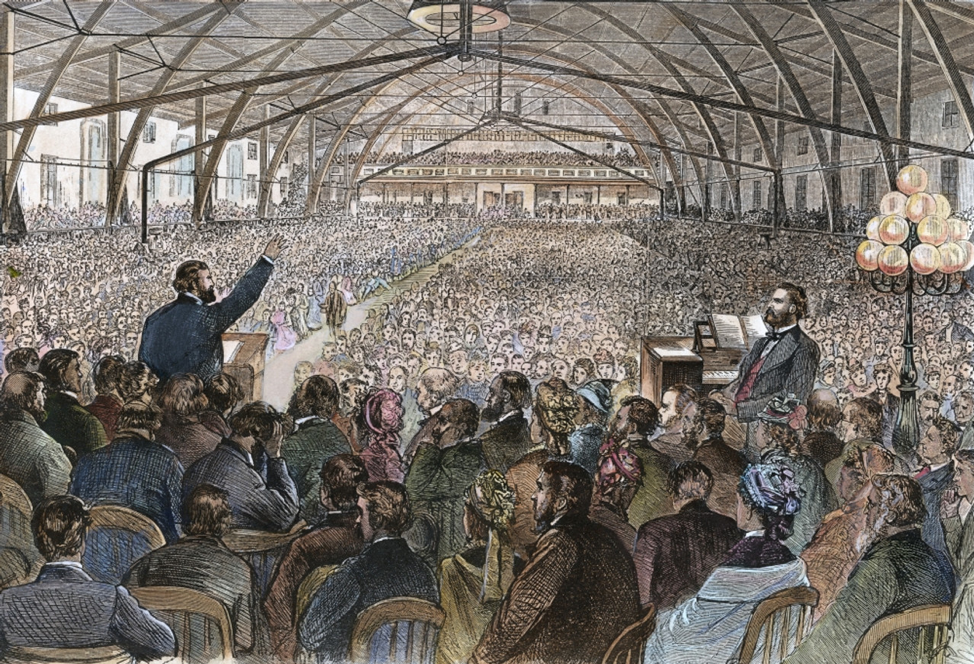
Far from being just a generalisation, the idea seems to have come directly from Engels’s experience of attending rallies by the evangelist Dwight L. Moody, ably assisted by the hymn-writer Ira D. Sankey on his harmonium, or “kist o’ whistles” as the irreverent Scots called it.
Engels saw the conversions at these rallies and was, of course, scandalised that they led to a reduction in revolutionary hatred of the exploitative class. Instead, disorganised lives became bourgeois lives, their despised nuclear families became stronger, and class resentment became work for a harmonious society. To ideologues like Marx and Engels, the masses’ failure to see Moody and Sankey as propaganda agents for their oppressors, inuring them to their sufferings by promises of “pie in the sky when you die,” was insufferable.
In fact, it appears that by the end of the nineteenth century, when Marx was dead, Engels old, and the “inevitable” revolution in Europe had not happened, Engels blamed the quiet situation in England specifically on Moody, Sankey and the Salvation Army. Marx’s economic theory had already been discredited by then, and the historian in the online discussion sees the Bolshevik Revolution as a kind of belated revival of Marxism, enabling the little-read texts of his books to become widespread, and his many unpublished ramblings to be resuscitated as Holy Writ for twentieth century revolutionaries.
I find the direct link between Marx’s hatred of religion and the Evangelical revival in England very interesting. It takes it out of the abstract realm into a direct confrontation of Communism with the Victorian Evangelical enterprise, of whose legacy I am a beneficiary. My Methodist ancestors would have heard Moody in East London in 1875, and my medical practice was founded by the grandson of one of the famous “Cambridge Seven” who served as missionaries in China as the result of C. T. Studd’s conversion through Moody.
Engels notwithstanding, it is important to note, as I did here, that evangelistic rallies and William Booth’s movement were not the sole manifestations of Christian influence on Victorian England. There seems a degree of consensus that the cultural influence was kick-started by the anti-slavery movement of Wilberforce and his circle. This attracted great popular support from Christians in the pews who could be broadly categorised as Evangelicals. Methodists and Evangelical Anglicans were prominent, but the records of Baptist churches like my own church also mention their support for the abolition movement. One must also acknowledge the prominent role of less orthodox groups like the Quakers, as well as more secular folk influenced by the Enlightenment. But though led by an elite, abolitionism was primarily a mass-movement of Bible-believing Christians.
As I describe in my linked article above, the success of slavery abolition kick-started probably the greatest programme of social improvement in English history, encompassing measures to protect animals, to nurture and educate children (and women), to improve the lot of workers, paupers and convicts, to reduce alcoholism, to mitigate industrialisation, and to spread the political franchise more widely. Not only were Christian values championed by Christians, but as salt and light they fostered in the uncommitted the high-trust society of philanthropy and probity that persisted into my lifetime.
And although it’s now controversial to say it, in these Marxist-dominated times, Evangelical sentiment also massively affected how Britain managed its more-or-less accidentally acquired empire. Nigel Biggar is worth listening to on this.
Consequently, although through the blinkered and cynical eyes of Marx and Engels religion simply anaesthetised the masses with vague hopes of heaven, in fact what prevented revolution in this country were the far more concrete matters of drains, clean water, decent housing, Factory Acts, economic growth, access to education and freedom of expression… as well as a prevalent gospel message of forgiveness of sins and love for neighbours.
What is notable is that, once Lenin was able to establish Marx’s New World Order by force, he not only destroyed Russians’ hope of eternity by a ruthless campaign against Christianity, but gradually eroded all such material benefits – even to the limited extent that they had already been achieved in a far less developed Christian nation than England. I gather that generations following mine have no idea of the damage and destruction that Communism in the Soviet Union wrought over seventy years – they are taught about Hitler, but not Stalin, nor Solzhenitsyn. Nor Mao. Nor Pol Pot. Nor Nicolae Ceaușescu, etc, etc. They have even been encouraged to forget the collapse of the Soviet Union through its economic and social failure, partly by setting up Vladimir Putin as a universal bogey-man.
Hearing about Engels and his attendance at Moody’s meetings, I was reminded of the visit of the American evangelist Arthur Blessitt to Cambridge when I was there, around 1972 or ’73. Blessitt was the guy who, after preaching in Hollywood, dragged a large cross around America, and then around the world (including Cambridge) preaching the gospel. He drew a pretty large crowd on Parkers Piece, and although I’m sure most of the Christian Union was there, I think most of the hearers were ordinary townspeople.
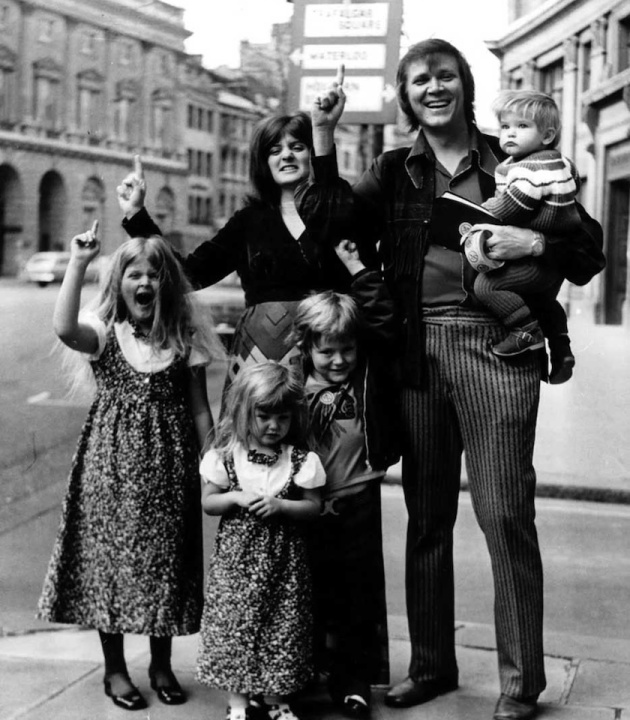
The gospel address was clear enough, though to be honest I found his getting his small children to sing “Jesus loves me, this I know” on stage a little cloying. But hey, he was a Yank! But as I listened, fairly near the back of the crowd, I noticed a small group of people nearby, whom I knew to be typical Cambridge lefties. One of them was a girl whom I’d worked with in physiology practicals in my first year, who had gradually become immersed in the whole post-Garden-House-riot culture of revolutionary socialism. She, like most of the others I ever encountered in Cambridge, was from a far more privileged background than mine.
What was clear was their utter contempt both for Arthur Blessitt, peddling opiates for the people, and for the lumpenproletariat too stupid to see through him to (presumably) his Capitalist masters. In other words, they appeared as Engels must have appeared to anyone standing close to him at a Moody meeting: aloof and superciliously self-assured.
The difference from Engels’s time is that the society we now suffer is the end result of the “Long March through the Institutions” initiated by the generation of Communists represented by the disdainful group on Parkers Piece. Back then, they also shouted down visiting speakers like the psychologist Hans Eysenck, despite the efforts of university authorities to protect free expression. Now they are running the universities, and most other centres of power, and free expression has gone.
Curiously, it seems to me that the society they have produced is a lot more like the dystopia Lenin initiated in Russia by inspiration of Marx and Engels, than it is like that morass of bourgeois contentment Engels associated with English Evangelicalism. A socialist utopia it is not. I suppose the Marxist response would be that there are still too many Christians holding back the Golden Age.