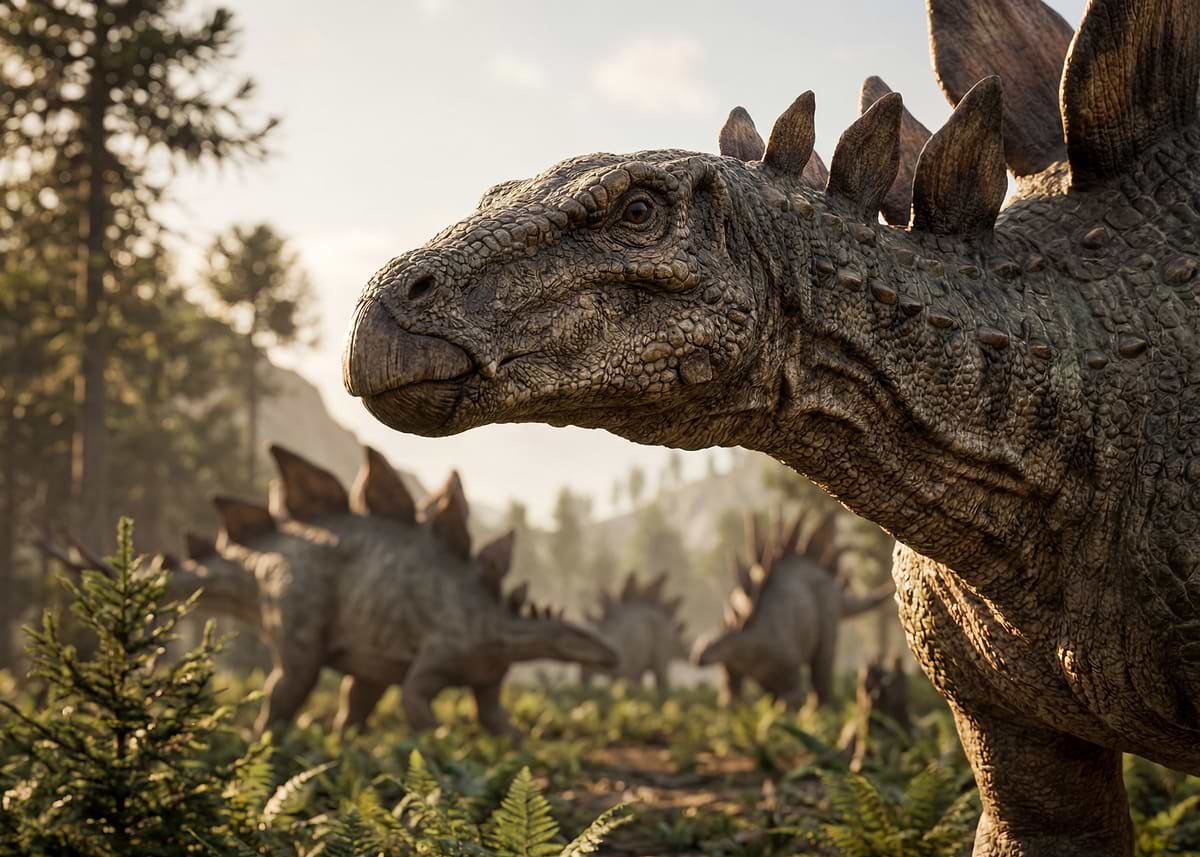
I briefly returned to my first scientific love, palaeontology, in the form of quite a nice video on the Stegosaurus. It was pretty well scripted, and voiced in a pleasant Tony Robinson-ish “educated cockney” voice, that only gave itself away as AI by the occasional phrasing error (and by saying “Steegosaurus” from time to time).
The striking thing was how far the techniques of palaeontology have progressed in my lifetime, enabling quite detailed analysis both of anatomy/physiology, and even lifestyle, for long-vanished creatures.
This is particularly so for the stegosaurs, which were once notoriously considered something of an evolutionary dead-end, with a brain the size of a walnut driving them to extinction. For example, my 1958 copy of The World We Live In, derived from a Life magazine series, which kick-started my entire interest in biology, identifies the example it illustrates thus:
Along the shore waddles Stegosaurus, weighted down by his probably useless spine plates.
The text stresses disparagingly that its 2½oz brain was equivalent to that of a small dog. It is interesting how, even in the 1950s before “junk DNA,” Darwin’s semi-divine natural selection, constantly ensuring that “all corporeal and mental endowments will tend to progress towards perfection,” could be accused, when required, of botching an entire genus for what we now reckon as some ten million years, or twenty for the entire order of stegosauridae.
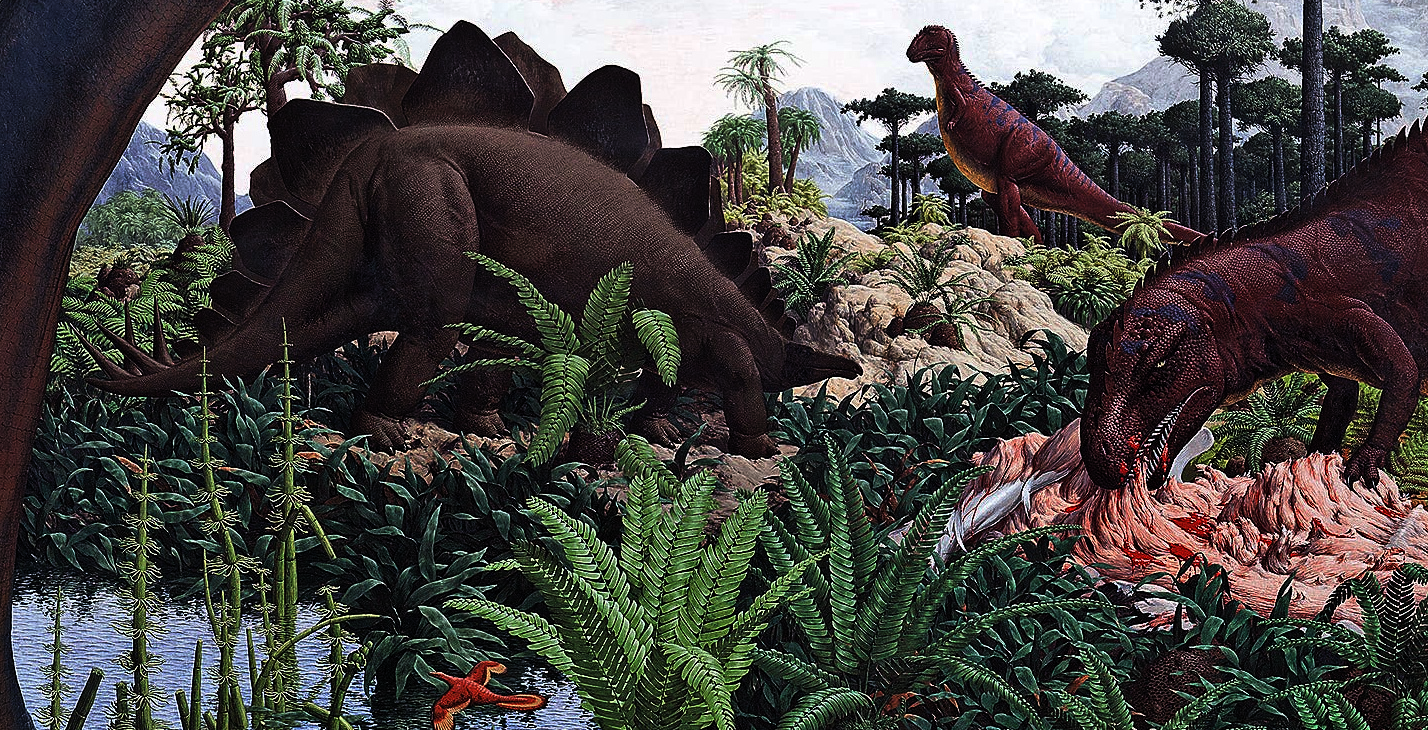
The video focuses on one fairly recent discovery of a particularly well-preserved Stegosaurus that was also far larger than was hitherto believed to be the norm, at around 27 feet long. This has enabled more detailed research, or at least given a hook to hang a review video on! It becomes clear that, as is so often the case, nature’s botch-job turns out to be a successful creature with a unique, highly sophisticated, fully integrated way of life that arose with the taxon, and persisted as losing as the genus did – which at ten million years is around the same longevity as an average dinosaur species. Little gradualism here: around eighty specimens so far found in the genus, all believed (by the majority) to come from just three species.
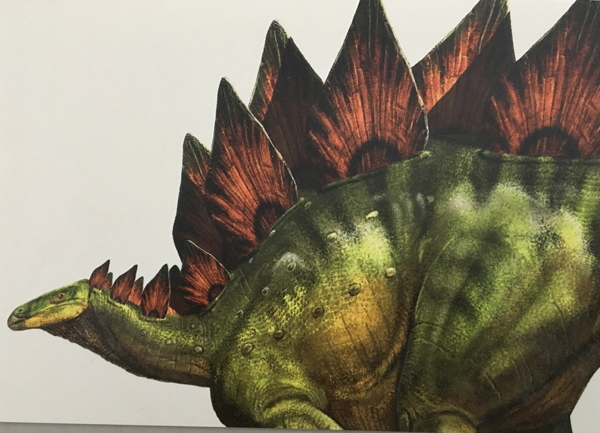
To cite the major points of the video, anatomically the “useless” plates are found to have been highly vascular, and covered in keratin, making for the same kind of efficient thermo-regulatory function served by the African elephant’s ears. Additionally, it is possible that changes in blood flow could alter the colour of the plates, whether to scare off the local Allosaurus, or to impress other Stegosauri.
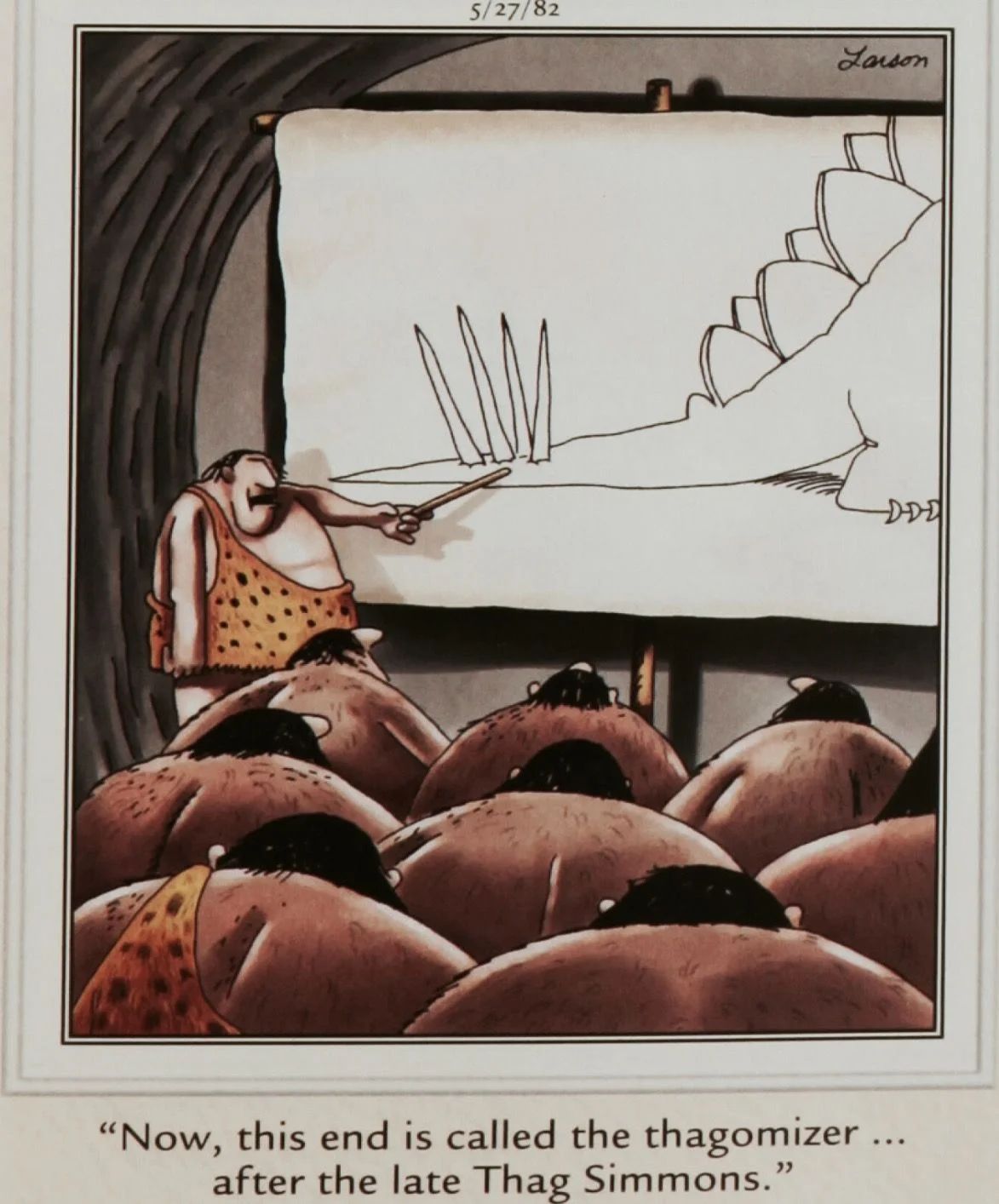
The tail spines, now officially termed the “thagomizer” after a Larsen cartoon, were once thought to have been swung around wildly and probably uselessly (silly old natural selection!). They now appear, from the lack of the usual dinosaur tail tendons and the indications of muscle attachments, to have been capable of accurate deployment as a weapon. A good percentage of specimens shows signs of damage in combat, and one detached spike was found embedded in an Allosaurus skeleton. It would even seem possible for the tail to be used in territorial or mating disputes, in a socially-ordered ritual way, with limited damage, as in the case of stags.
Thirdly, the discovery of Stegosaurus trackways has established that they travelled in organised groups, and moreover that the larger individuals moved on the outside of the smaller ones, presumably to protect them in the same way that elephants do their young.
With this evidence of social organisation, it remains something of a mystery how it could be organised with 2½oz brains. Maybe the columnist Bert Leston Taylor was not so far off the mark after all! (Incidentally, Taylor published his poem, which I was delighted to learn by heart as a teenager, in the Chicago Tribune on 26 February 1903, just “one day after the paper reported that Oliver C. Farrington of the Field Museum, examining vertebrae from a recently unearthed sauropod, had found a spinal cavity that might have held a second brain.” Taylor’s brain was certainly larger than that of a small dog!
My takeaway lesson from this video is that the doubts about the explanatory power of random mutation and natural selection, raised by systems biologists like Denis Noble as well as by ID researchers, are found to be as relevant in the Jurassic as they are in modern physiology. In the laboratory, natural selection appears as a tinkerer with ultra-rare beneficial mutations. Mainstream biology has been forced by the evidence into favouring near-neutral evolution in which most change is random and beyond selection, and therefore mildly deleterious. Natural selection appears to act mainly as “purifying selection” to limit the damage to the species, rather than to innovate. Such a process might well create a creature with “useless” features, though one would not expect it to thrive for ten million years surrounded by apex predators like Allosaurus.
Yet in the fossil record, and in living species, the closer we look the more optimised the organism is at every level, from the molecular to the social. The obvious conclusion is that whatever gave the stegosaurs their orderly place under the sun for twenty million years, it could not have been Neo-darwinian evolution.