If Adam wasn’t alone, then what?

A. Leo Oppenheim, writing in the Complete Dictionary of Scientific Biography on Man and Nature in Mesopotamian Civilization, makes an interesting (and usually unnoticed) distinction between the two “creation stories” of Genesis.

The relationship between man and nature in the ancient Near East is nowhere as pointedly formulated as in Genesis 1:26, where it is said that God gave man “dominion over the fish of the sea, and over the fowl of the air, and over the cattle, and over all the earth, and over every creeping thing that creepeth upon the earth.” The parallel version of the Creation story (Genesis 2:19) formulates the same relationship differently, and in a way that is more relevant to the characteristic attitude of those civilizations that relied on writing for the preservation of their intellectual traditions. It says, “God formed every beast of the field, and every fowl of the air; and brought them unto Adam to see what he would call them: and whatsoever Adam called every living creature, that was the name thereof” While it was thus man’s privilege as the lord of creation to give names to the animals, the knowledge of all their names and their individual features and behavior was considered the privilege of the sage. This is illustrated by the passage (I Kings 4:33) that extols the wisdom of Solomon: “And he spake of trees, from the cedar tree that is in Lebanon even unto the hyssop that springeth out of the wall: he spake also of beasts, and of fowl, and of creeping things, and of fishes.”
Continue reading

Posted in Adam, Creation, Genealogical Adam, Theology | 5 Comments

Essences, fuzzy or firm

In this post, on the possibility of “adamic man” living with some other kind of “humanity”, I dropped in a passing comment on the difficulty for Darwinian gradualistic evolution of being able to come to grips the meaning of a word like “human” at all.

Merv picked this up (remembering at least one exchange on universals we’ve had in the past):

Does the fact that we can’t look at our continuous visible spectrum and point precisely to where it stops being red and starts being orange (other than by arbitrary selection of a cutoff frequency) mean that there can be no sustainable category of “red” colors?

It just doesn’t seem to follow that an inability to define precise boundaries negates entire (and nevertheless important!) categories.

Continue reading

Posted in Adam, Creation, Philosophy, Science, Theology | 25 Comments

Talking with the animals

In the rich discussion arising from this piece (thanks to Colossian Forum for the original stimulus), pngarrison comments:

The possibility of Adam and Eve being one couple among a population, with only their descendants being fully human makes no sense to me. Their descendants would be confronted with how to treat the sub-humans who looked like them, made a living like them, possibly talked like them. How would they even tell for sure who was fully human and who wasn’t? If they could tell the difference, would it be o.k. to treat the sub-humans like animals? If they were in the middle East, you end up saying the people in the rest of the world weren’t fully human – it sounds like 19th century racism.

Continue reading

Posted in Adam, Creation, Science, Theology | 2 Comments

The literal literal meaning of Genesis

This recent highly-commented post, and a local request to teach on the recent insights into the biblical creation story, have put my mind back on to Genesis. I’ve use this illustration before:

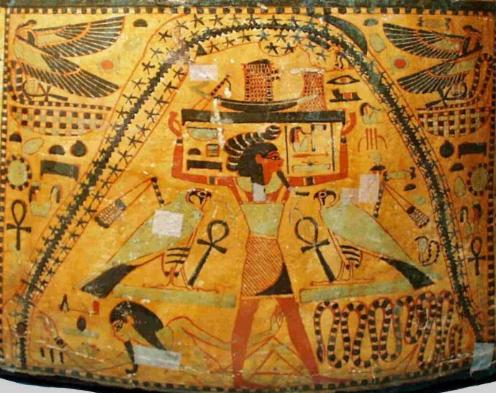
nut-y-geb

Continue reading

Posted in Creation, Science, Theology | 1 Comment

Hungry for You

I heard yesterday of the sudden and tragic death of a young friend of mine. In 2003 she played flute on one of my songs, which I attach here as a tribute to Claire’s memory.

Posted in Music | 2 Comments

Primary reality

There’s an interesting take on the historicity of Adam on the Colossian Forum, as part of a project funded by BioLogos, Beyond Galileo – to Chalcedon: Re-imagining the Intersection of Evolution and the Fall, of which at least one of our readers, J Richard Middleton, is a participant. Continue reading

Posted in Adam, Creation, Science, Theology | 35 Comments

It’s an old trick…

So, one death-affirming jihadist has been “outed”, with the resulting danger that by demonizing him our mainstream press will, once again, fail to notice they are increasing his propaganda value. Continue reading

Posted in Creation, Politics and sociology | Leave a comment

How order develops spontaneously in news

This Independent headline caught my eye: New theory could prove how life began and disprove God. As you’ll see, that’s the sub-editor’s sense of priority: the article itself just says the new theory “throws out the need for God”. The Indie’s source, with its stress on the punch-drunkness of God and the terror of Christians, is actually a piece by Paul Rosenberg at the Richard Dawkins Foundation, rather than the original review in Quanta Magazine. The latter was obviously un-newsworthy when it appeared over a year ago as it just mentioned the science, not the demise of God. Quanta was itself a secondary source for the work of physicist Jeremy England, making the Independent headline 5th hand (and this piece of mine 6th hand!) journalism. Continue reading

Posted in Creation, Philosophy, Politics and sociology, Science, Theology | 1 Comment

Why I am not a postmodernist

Well, I’ve finally struggled through Michel Foucault’s The Order of things, much in the manner of someone destroying his health trying to cross the Sahara on foot, but too stubborn to give up. The enterprise started well – his preface laid out the bones of a thesis that there have been fundamental changes in the very patterns of thought, especially scientific thought, of which he proposes three since the sixteenth century. These changes are far deeper than the changing science itself, and he describes them as being at an “archaeological” level, and the result of rather mysterious forces rather than any new discoveries or increase in rationality. Continue reading

Posted in History, Philosophy, Politics and sociology, Science | 4 Comments

The presentation of self in everyday ecology

Apologies to sociologist of my youth Erving Goffmann for the title. Our friend Hanan, as always perceptive, e-mailed me with some quotes from a blog, or perhaps a conversation, on ecology:

Ecosystems adapt not because they’re in harmony, but because they’re in tension. Sometimes that tension yanks everything in a new direction when things are changed, and sometimes everything falls apart…

“Harmony” suggests that everything is working together. What’s really happening in an ecosystem is that everything is working on its own, and on its own, for its own reasons (so to speak), reacting to everything around it. Even symbiosis, like between bees and flowers, isn’t the bees and flowers working together, but the bees getting as much as they can out of the flowers and the flowers getting as much as they can out of the bees. They’re in tension with each other, each trying to get the most use out of the other while expending as little of its own resources as possible.

Continue reading

Posted in Creation, Philosophy, Science, Theology | 5 Comments